
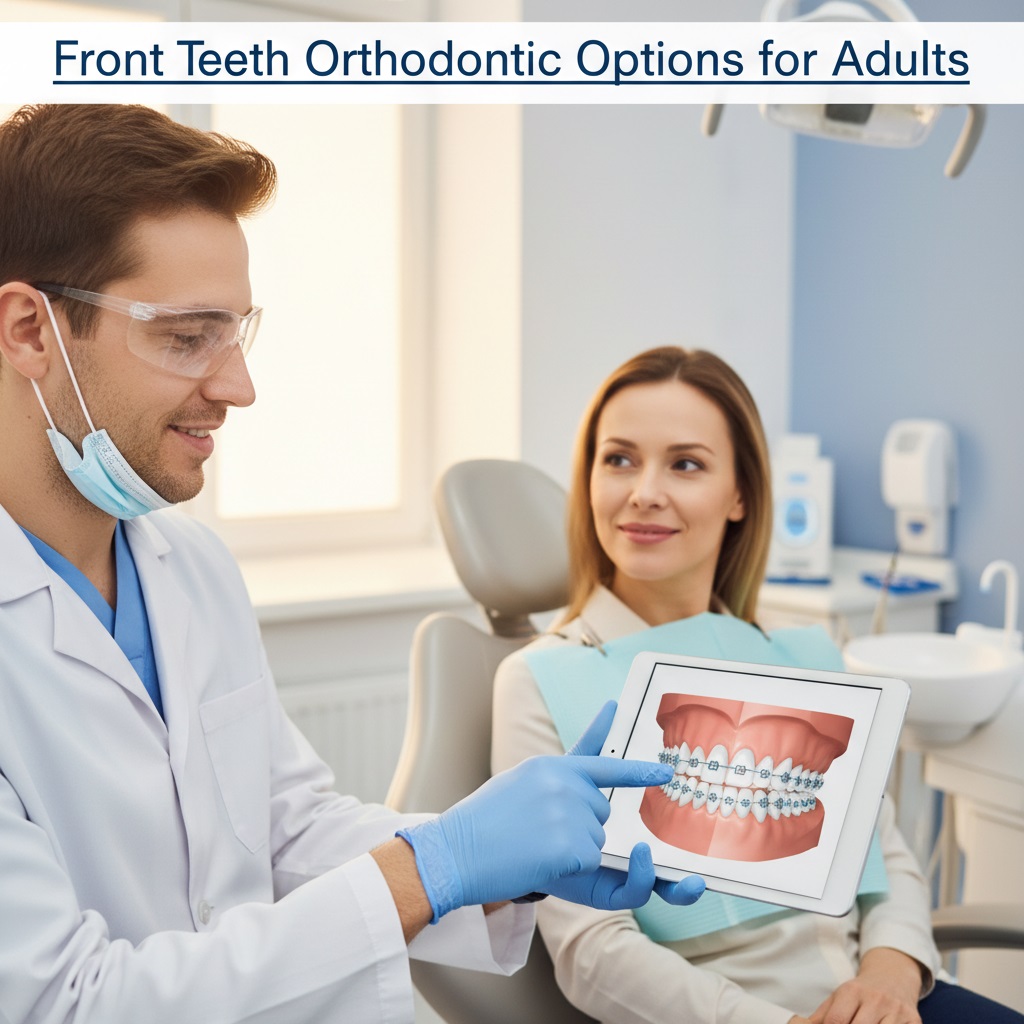
When Only Your Front Teeth Need Fixing: How Dentists Decide The Right Orthodontic Tool
Most adults don’t walk into a clinic asking for a specific orthodontic system.
They walk in with a problem.
“My front teeth have moved.”
“My smile looks off again.”
“I don’t want braces, but I want this fixed properly.”
What happens next matters more than the appliance itself.
Because not every misalignment needs full orthodontic treatment. And not every fast option is safe. The real skill lies in knowing when less treatment is the right treatment.
Table of Contents
Why Dentists Separate Front-Tooth Movement from Full Orthodontics
The front teeth behave differently from the rest of the mouth.
They sit on thinner bones.
They experience different pressures during chewing.
They respond faster to orthodontic force.
That is why, in adults, minor front-tooth movement often shows first, even when the bite behind remains stable.
From a clinical point of view, this creates two paths:
- Full orthodontic correction when the bite and back teeth are involved
- Targeted correction when the issue is cosmetic and limited to the visible front teeth
Choosing the wrong path leads to overtreatment or poor results.
The Clinical Question Dentists Actually Ask
Before recommending any appliance, the decision is usually based on one core question:
Is this a cosmetic alignment issue or a bite problem?
If the bite is balanced and healthy, and the concern is limited to:
- Mild crowding
- Small gaps
- Slight flaring
- Minor rotations
- Relapse after previous braces
Then, full-mouth treatment is often unnecessary.
This is where short-term orthodontic tools come into consideration.
Why Targeted Systems Exist at All
Targeted orthodontic systems were not created to cut corners. They were created to solve a very specific adult problem.
Adults want:
- Faster outcomes
- Lower treatment burden
- Fewer appointments
- Minimal lifestyle disruption
When the treatment goal is limited to the front teeth, applying controlled force to only that area is both logical and predictable.
One such system is the Inman Aligner, used in carefully selected adult cases to reposition front teeth efficiently.
Where the Inman Aligner Fits in Clinical Decision-Making
The Inman Aligner is a quick orthodontic aligner, not a universal solution.
Dentists consider it when:
- The jaw is fully developed
- Gum and bone health are stable
- The bite does not require correction.
- The tooth movement needed is mild to moderate
- The patient can commit to daily wear time
Because the system applies pressure from both sides of the teeth, movement can happen faster than staged clear aligner systems in suitable cases.
That is why treatment often completes within 6 to 18 weeks.
Speed here comes from focused movement, not aggressive force.
What Makes or Breaks Results
In targeted orthodontics, outcomes depend on three things.
- Case selection
Using the system only where it belongs. - Patient compliance
Wearing the appliance for 16 to 20 hours a day is non-negotiable. - Retention planning
Straight teeth without retention do not stay straight.
When all three are handled correctly, results are stable and predictable.
Why does this approach suit many adults in Sydney
Many adult patients want improvement, not perfection.
They want:
- Their smile returned to how it looked before relapse
- A solution that fits work and social life
- Clear expectations and honest limitations
At Clear Braces Orthodontics, treatment planning starts with clinical suitability, not appliance preference. If a targeted approach is appropriate, it is discussed. If not, alternatives are explained clearly.
That honesty protects results.
The Right Tool, Not The Biggest Tool
Orthodontics is not about doing more.
It is about doing what is needed and no more.
When front teeth are the only issue, targeted treatment can be the smartest choice. When they are not, shortcuts create long-term problems.
A proper assessment decides the difference.
FAQs
Ans. Yes, if the bite is stable and the movement required is mild to moderate.
Ans. Front teeth can respond relatively quickly, but safe movement still depends on controlled force and wear time.
Ans. Only with proper retention. Without retainers, teeth can shift again.
Ans. Clear aligners are excellent for full-mouth movement. They are not always the most efficient option for front teeth only.
Ans. Only a trained clinician after examining tooth position, bite, and gum health.
Dr. Manish Shah
BDS, MBBS, MMED (Sleep Medicine)
- Masters in Sleep Medicine
- General Medical Practitioner
- General, Implant and Cosmetic Dentist
- Certified in TMJ & Craniofacial Pain Management